

Hermès on Bond Street: six Georgian houses, one Maison
Hermès has joined six listed buildings on New Bond Street to create its largest store in Europe, with 55 rooms, 500 works of art, a non-traditional orangerie, and leather craftsmen at work on the third floor. Block out half a day to visit, you'll need it.
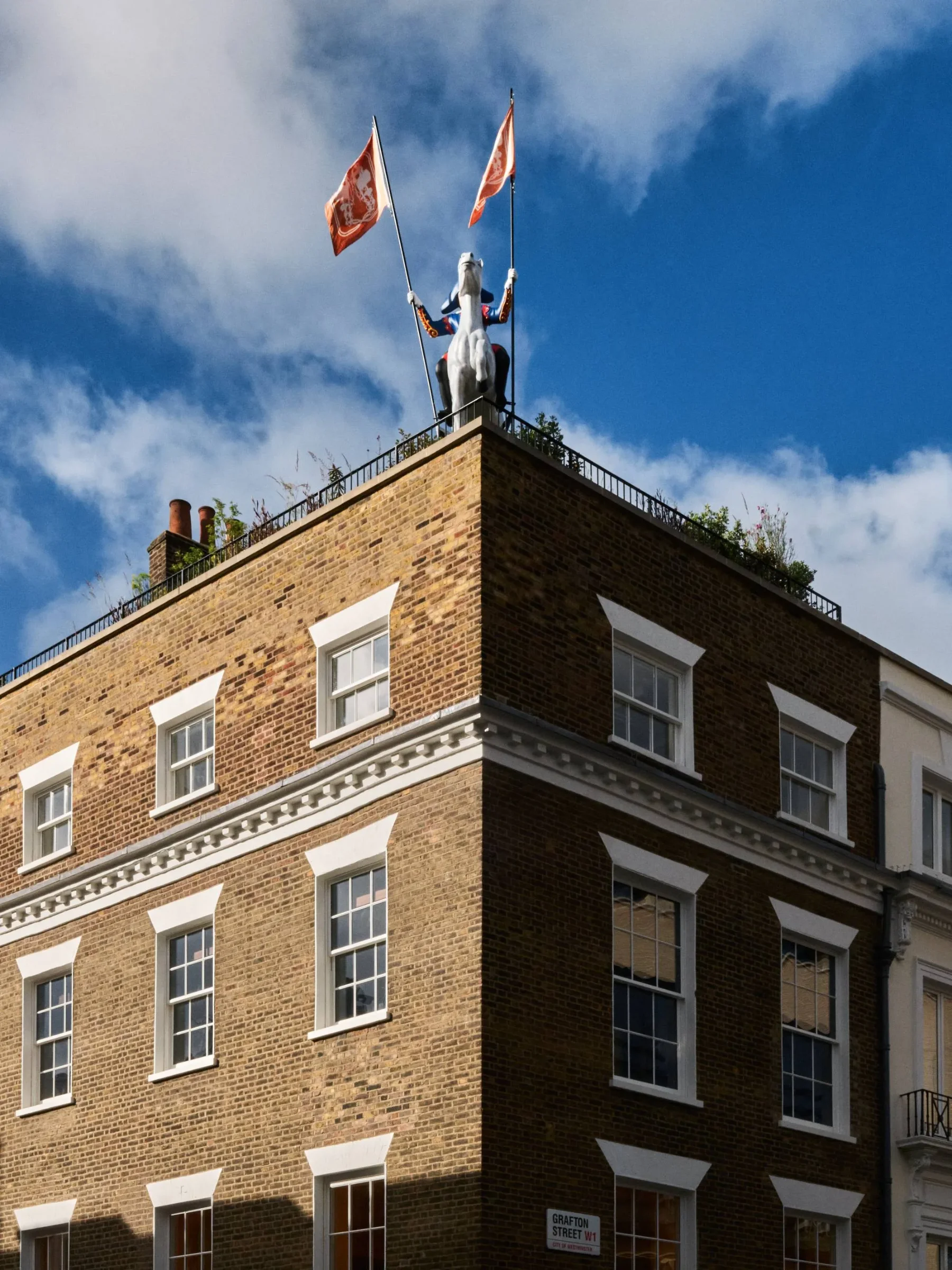
The new Hermès Maison at 166 New Bond Street, which opened on 16 June, gives very little away from the pavement. It is handsome but restrained: a seven-metre façade with six arched windows, and only when you go in do you realise how far back it runs. Behind the shopfront, Hermès has stitched together six Grade II-listed buildings, the oldest dating from 1769, running from 165 to 167 New Bond Street through to Grafton Street and Albemarle Street behind. The result is around 2,000 square metres over five floors, with 55 rooms, four staircases, three lifts and two roof terraces.
It replaces the old shop at 155 New Bond Street and the concession in Selfridges, and it is the house's sixth Maison anywhere in the world, as Hermès calls its largest stores, alongside the original on the Faubourg Saint-Honoré in Paris.
A house of rooms
The interiors are by RDAI, the Paris studio founded by Rena Dumas that has designed Hermès shops for decades, under the artistic direction of Denis Montel, working with Foster + Partners on the structure. They have kept 55 separate rooms instead of knocking through into one vast hall, and I think that decision gives the place its character. You move through it as you would a large townhouse, from a panelled room into a mosaic-floored passage and on into a room hung with blue Lancashire wallcoverings, and each turn brings something new to look at.
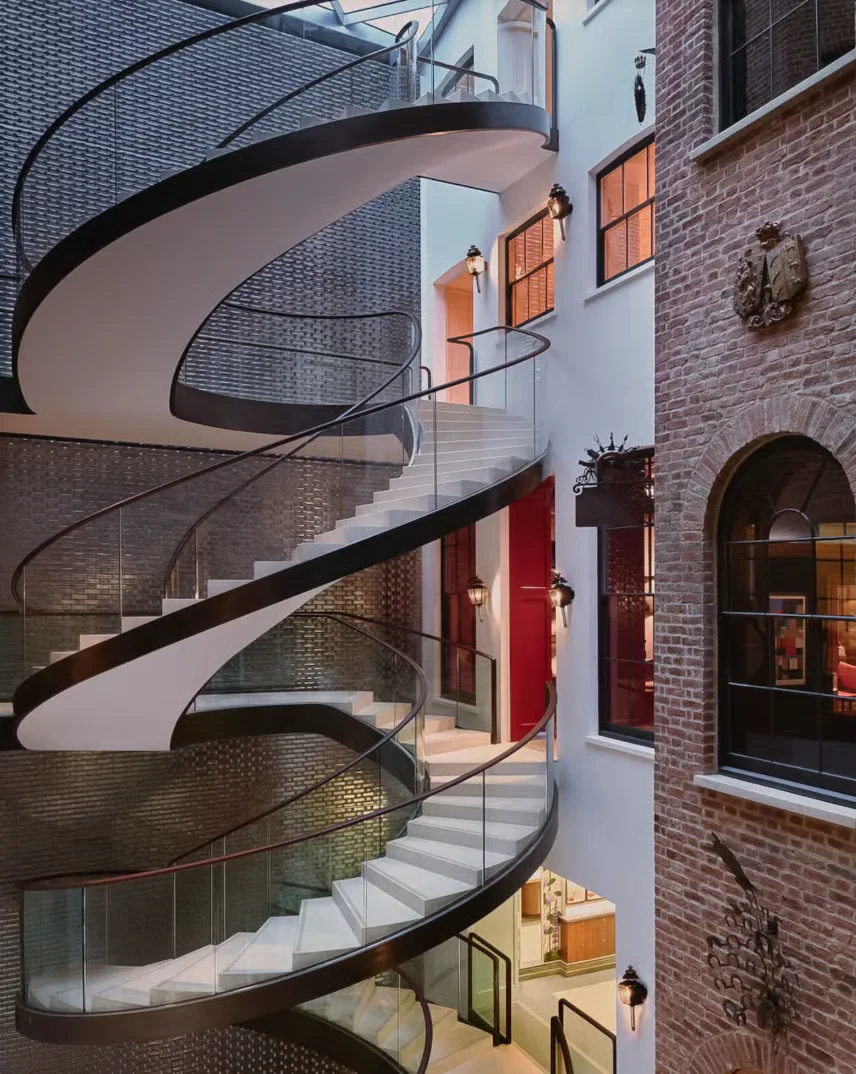
The craftsmanship is extraordinary, and much of it is British. At the entrance, the floor carries the Faubourg pattern and the ex-libris emblem of the house. The handrail of the limestone and glass staircase is wrapped in calfskin. There is hexagonal oak parquet on the first floor, panelling in straw marquetry and horsehair in the equestrian rooms, patinated copper panels, yellow Siena marble skirting, original 19th-century mosaic floors and walls of powder-pink mineral mortar. Hermès says most of the ornament and colour was sourced in Britain and made by British craftspeople and artists, and the blue Lancashire walls and Manchester bricks give it a strong sense of being in London.
The atrium and the orangerie
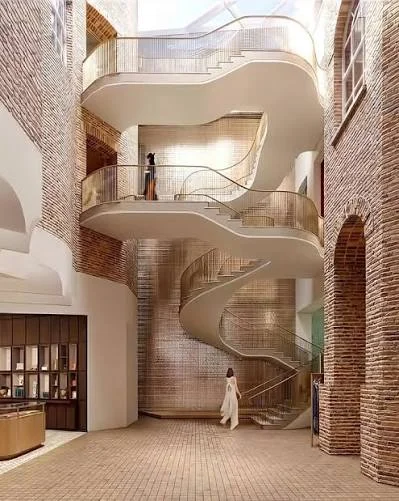
The heart of the building is an atrium that was once an open courtyard. Foster + Partners raised a steel and glass roof over it by a floor, added a spiral staircase below and carried the staircase up two more storeys, and the south wall, once mirrored, is now lined with Manchester bricks cast in mirrored glass. A horse by the British sculptor Jessica Wetherly stands in the middle, a reminder that Hermès began in 1837 as a Paris harness-maker.
On the ground floor, through the second entrance, is what the house calls its imaginary orangerie, given over to beauty, fragrance and fashion jewellery, with walls drawn by the London illustrator Katie Scott, whose botanical work is as precise as an old engraving. The silks line the route from the street into the atrium, so that you walk past carrés before you reach anything else.
Floor by floor
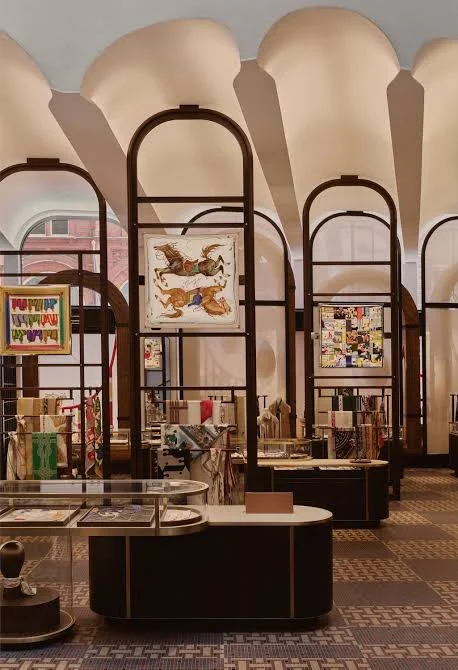
The first floor comprises twenty interconnecting rooms. Leather goods sit in rooms washed in deep reds; two private salons for clients; five rooms for the home collections; six for watches and fine jewellery; and, at the centre, the full equestrian collection, saddles and all. The second floor is for women's shoes, women's ready-to-wear, and the men's collections, with a small tea-and-coffee room overlooking the atrium, which, to my mind, has the best seat in the building.
The third floor is the part I find most encouraging. Hermès leather craftsmen work there in view, and much of their time is spent on repairs. A bag bought here can be brought back and mended for decades, and I love that Hermès has given a whole floor of prime Mayfair space to keeping old things in use. The fourth floor is private, with rooftop salons, two gardens and pieces from the Émile Hermès Collection, the family's own archive of saddlery, travel objects and curiosities.
Art everywhere
Pierre-Alexis Dumas, the house's artistic director, has chosen around 500 works of art to hang through the building, and they turn up in the most unexpected corners, between shelves of scarves and above the leather counters. The windows for the opening were given to the textile artist Kate Jenkins, whose Rocabarn is a horse-grooming parlour made entirely in crochet, knitting and embroidery, and it is very funny and quite obviously took months of patient work.
Should you go?
You do not need to buy anything to enjoy a visit at this fabulous store. It's a lifestyle experience more than a shopping trip. Go on a weekday morning, before the crowds, walk the first floor slowly, and stop for a coffee overlooking the atrium. If you are hoping to walk out with a Birkin, nothing has changed; the famous bags are still offered to clients with a long relationship with the house, and a beautiful new shop will not shorten the wait. One London investor wrote after the opening that the store was designed not for today's clients but for those of 2035 and 2040, and having read about it in detail, I think he is right. This is Hermès planning for its next half-century in London, and doing it with real care.
The details
Hermès Maison, 166 New Bond Street, Mayfair, London W1. Opened 16 June 2026. Five floors and 55 rooms across six Grade II-listed buildings, around 2,000 square metres, all sixteen Hermès métiers, including leather goods, silk, ready-to-wear, equestrian, home, watches, jewellery and beauty. hermes.com